
Whenever you think of K-Pop, you might picture K-Pop Demon Hunters, BTS, BLACKPINK, “Gangnam Style,” or overly obsessed fans. To some extent, those associations exist for a reason, that’s how stereotypes work. However, K-Pop is far more complex than the surface-level image many people have created. There are countless groups, sub-genres, and both positive and negative sides to the industry.
K-Pop culture is a global phenomenon that blends Korean and Western musical influences with high-production visuals, high-energy choreography, and deeply engaged fandoms. Key parts of the culture include streaming music, buying merchandise, idol training, and the concept of Hallyu, a Chinese term that literally translates to “Korean Wave,” used to describe the worldwide rise of Korean culture.
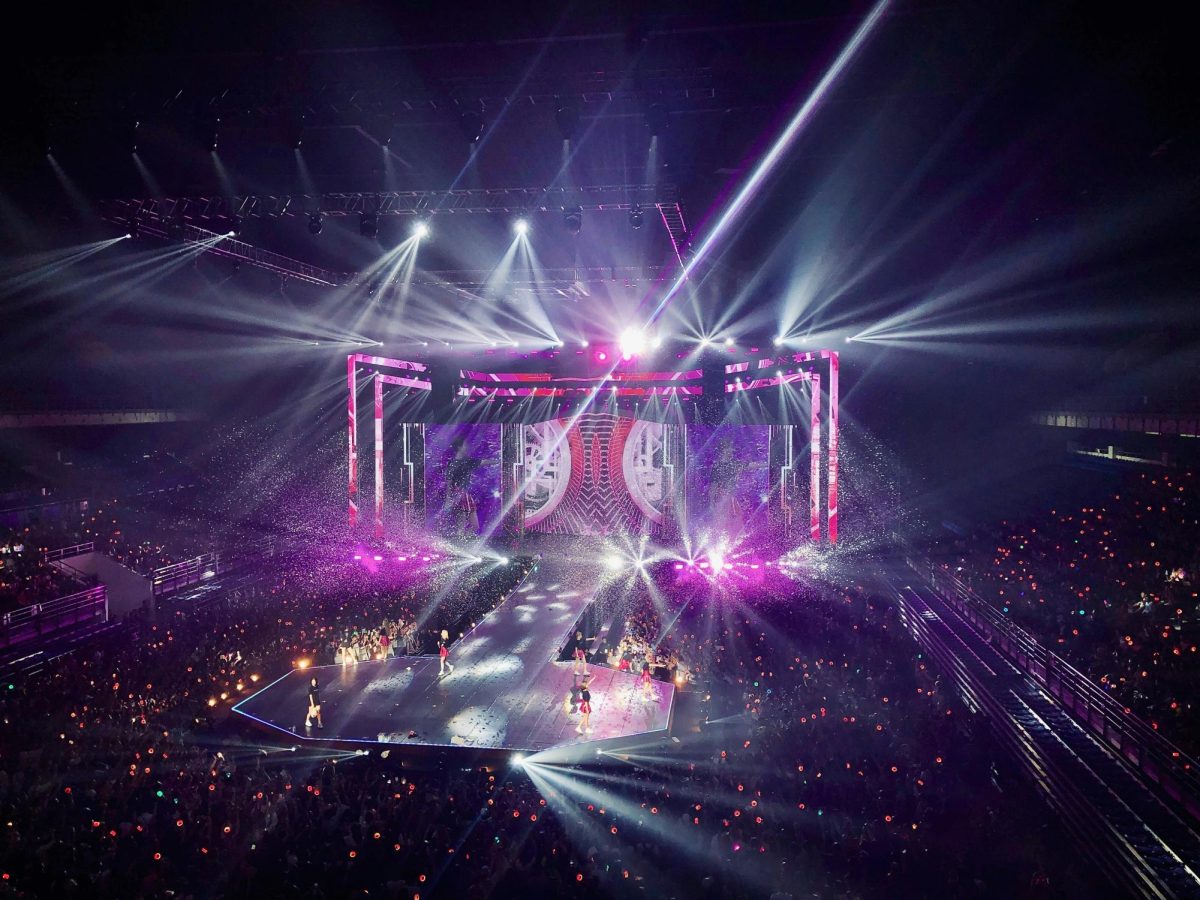
Most K-Pop groups also have official lightsticks, which serve as powerful symbols of fan identity, unity, and support. At concerts, they turn the whole venue into a glowing ocean of light. Lightsticks also function as official merch and branding tools, allowing fans to visually represent their fandom and helping artists easily spot their supporters during performances.
A stereotype is a widely held, oversimplified belief about a group of people. It assumes everyone in that group shares the same traits, behaviors, or characteristics. While stereotypes act as mental shortcuts, they often lead to unfair judgments, bias, and the inability to see individual differences.
A major stereotype about the K-Pop industry is that it’s “robotic” — that idols are fake, have no personality, or are manufactured. People often claim idols are “plastic,” look the same, can’t sing, or follow the same formulas. Fans and idols alike constantly deal with these assumptions. For example, whenever Natalie mentions she likes K-Pop, people immediately assume she’s a fan of BTS or BLACKPINK. She doesn’t dislike those groups, but she doesn’t follow them either. Natalie said that it discouraged her from talking about the things she enjoys as she’s now more afraid of being judged or made fun of.
Another stereotype is that idols are only visuals with no real talent, which is far from the truth. Western expectations also play a role. In many Western cultures, men are expected to be hyper-masculine, and anyone who doesn’t fit that mold is often judged or labeled. In contrast, Korean culture embraces softer masculinity. Men commonly wear makeup, jewelry, and fashion that the West might consider feminine. It’s also a common thing in Asia to be clean-shaven to be considered good-looking or clean, completely different from our ideas of what a man should look like.
Summarizing K-Pop in one word is impossible. It’s fun, exciting, and community-driven, but there are also harmful realities that many people overlook, especially those who glamorize the industry without understanding it. The truth can be a culture shock.
People often picture the idols receiving constant tour revenue, adoring fans, exciting relationships, and companies catering to idols’ every need. While it’s possible to have the “perfect” idol life, it usually just happens in fiction. Trainees are trained as young as 7-years-old, and they debut only when the company decides they’re ready. Many who have been through the system describe it as “intensely demanding, highly competitive, and physically and mentally grueling.” It’s like a living hell. The youngest person known to become an idol is Xuan from BOYSTORY, who debuted at just 11-years-old.
Idols and trainees also face strict contracts with heavy restrictions. These may include dating bans, unfair revenue splits, strict diets, limits on what clubs you can go to, bans on tattoos or swearing, and rules against discussing politics. Many companies even require trainees to delete or private old social media accounts. The exact rules depend on the company, but some are far stricter than others.
Even after debuting, success isn’t guaranteed. The competition is high, with groups like Stray Kids, TXT, aespa, IVE, ENHYPEN, LE SSERAFIM, and BLACKPINK constantly dominating charts and public attention. And in 2026, BTS, who are arguably the most influential boy group in the world, are returning from a four-year hiatus due to military service. Their comeback will likely overshadow many other groups’ debuts and comebacks.
Before you can say that you’re an idol, it’s extremely difficult to do. Only about 0.1-1% of trainees ever debut. On top of that, K-Pop companies are often criticized for “westernizing” their groups, as English lyrics and multinational members become more common; yet racism remains a major issue in the industry. ENHYPEN’s Ni-ki, who is Japanese, has been told he looks “too Japanese” and faced waves of hate as a teenager, even apologizing for his ethnicity. Fatou from BLACKSWAN has experienced discrimination because of her dark skin. TWICE’s Tzuyu faced backlash and even a forced apology at age sixteen simply for holding the Taiwanese flag.
You might wonder where all of the hate comes from. Surprisingly, it usually isn’t the companies fueling it. Instead, most negativity comes from netizens, both South Korean and Western, meaning people who are active, frequent users of the internet. These online communities can be incredibly passionate, but that passion easily can turn into harsh criticism, misinformation, or uncalled-for hostility.
Seeing how harsh the internet can be toward idols made me, Natalie, hesitant to get involved with K-Pop fandoms at all. However, something about the group Stray Kids stood out to me, and I found myself drawn to their music anyway.
Stray Kids is an eight-member K-Pop group consisting of Bang Chan, Lee Know, Changbin, Hyunjin, Han, Felix, Seungmin, and I.N. They debuted in 2018 under JYP Entertainment and later signed with Republic Records in 2022. Over their eight years of activity, they have released more than 40 studio albums, mini albums, and other projects — remarkably, all self-produced.
I first discovered the group in the summer of 2023 through their title track “Maniac” from the album ODDINARY. Choosing a single favorite song is nearly impossible, but “Levanter” has always stood out to me. Its meaning becomes even more powerful once you understand what the group was experiencing during that era.
To me, Stray Kids represents a team of artists who genuinely care about their craft. While I don’t know them personally, everything I’ve read about their behind-the-scenes behavior suggests that what you see on camera is close to who they really are. Their talent is undeniable, fans often joke that the group has “8 rappers, 8 dancers, 8 vocalists, and 8 visuals.” Watching them perform makes it easy to understand why.
Another group we listen to is LE SSERAFIM. LE SSERAFIM is a five-member girl group under HYBE and Source Music. The current lineup includes Kim Chaewon, Sakura, Huh Yunjin, Kazuha, and Hong Eunchae. Originally, the group debuted with six members, but Kim Garam departed on July 19th, 2022, following a school bullying controversy that was later proven false. LE SSERAFIM debuted on May 2nd, 2022, with their mini album FEARLESS. Their name, when unscrambled, forms the phrase “I’m Fearless,” and is inspired by “LESSERAPHIM,” referencing the six-winged heavenly beings known as seraphim. Their fandom name, FEARNOT, is a Korean homonym for “blooming,” symbolizing the idea that the group and their fans will move forward fearlessly and grow together.
Although neither of us has explored their full discography, we both see LE SSERAFIM as a passionate and relatable group, often considered one of the strongest girl groups of the fourth generation. Some of Dylan’s favorite songs are “CRAZY” and “Spaghetti,” while Natalie enjoys “Come Over” and “Perfect Night.”
A group Dylan likes is BLACKPINK. BLACKPINK is a four-member girl group under YG Entertainment, consisting of Jisoo, Jennie, Rosé, and Lisa. They debuted on August 8th, 2016, with their single album Square One. In 2018, they signed with the U.S. label Interscope Records, expanding their global reach. On December 29th, 2023, all four members renewed their contracts with YG Entertainment for group activities while choosing to pursue their solo careers independently. Lisa now runs her own agency, LLOUD; Jennie founded ODD ATELIER; Jisoo operates under BLISSOO; and Rosé is signed with THEBLACKLABEL. Their fandom is known as BLINK.
My (Dylan’s) first experience with BLACKPINK was in middle school through one of their songs featured in Just Dance. I enjoyed the track but never explored their music deeply until recently. Their latest release, “JUMP,” is incredibly catchy and fun to listen to. Natalie isn’t a major fan of the group but enjoys several of their songs, especially their individual releases.
Naturally, BLACKPINK’s long career has earned them a good list of awards. But looking at that list raises a bigger question: with so many ceremonies and categories, how does the K-Pop awards system actually work?
K-Pop award ceremonies typically take place at the end of the year and continue into the next. Major categories include Artist, Song, and Album of the Year (known as Daesangs), along with awards for Best Male/Female Artist, Best Group, Rookie of the Year, and performance-focused categories such as Best Dance, Vocal, Rap, and Band Performance. There are also genre-specific awards like Hip-Hop, R&B, Trot, and Rock — as well as global and popularity-based awards such as Worldwide Act or Fan Choice.
A group’s chances of winning depend on a combination of album sales, streaming numbers, music video views, expert evaluations, and fan voting. Unfortunately, award season often brings controversy. Fans of groups who don’t win sometimes accuse companies of buying votes or rigging results. This mindset is toxic and unfair, especially considering how hard idols work for their achievements.
Despite the negativity that sometimes surrounds K-Pop, much of it is preventable. Companies should avoid giving in to overly judgmental fans, and people who bully idols for their appearance or mistakes need to step back and reflect. A more empathetic, realistic, and open‑minded approach within fandoms would make the community far healthier.
If you decide to get into K-Pop and participate in fandom spaces, remember that idols are human. They will look, act, and make mistakes like any other person. Treating them with respect and understanding is essential, not just for them, but for the community as a whole.
Sources:
https://kprofiles.com/stray-kids-members-profile/
https://kp rofiles.com/le-sserafim-members-profile/
https://kprofiles.com/black-pink-members-profile/
https://en.wikipedia.org/wiki/Tzuyu_Incident
https://www.billboard.com/lists/k-pop-artist-100-2025/
https://www.quora.com/What-are-some-stereotypes-of-K-pop-idols
https://medium.com/bulletproof/prejudices-surrounding-idols-fandom-and-bts-3d29143e4197
https://www.reddit.com/r/popheads/comments/fr9la2/kpop_101_explaining_kpop_in_depth_charts/