
Artificial Intelligence has become immensely popular in recent years for its ease and low costs to use. The most controversial of which is generative AI, which uses work made by humans to train it to create something new. Some worry about the ethics of it all, while others worry about how it may affect the environment, but how will generative AI likely affect our futures?
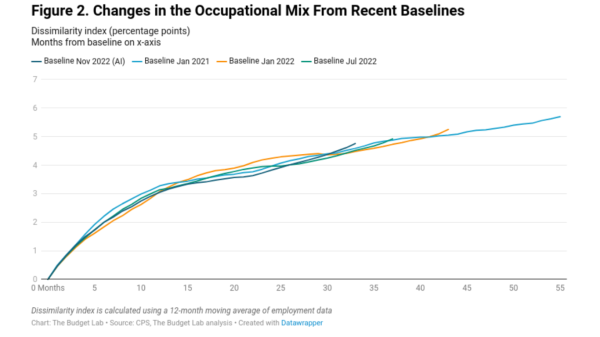
Skeptics fear AI taking over people’s jobs and causing damage to the job market. In Evaluating the Impact of AI on the Labor Market: Current State of Affairs, by the Budget Lab at Yale, it states, “Although recent trends seemingly outpace historical shifts in the occupational mix, the potential effects of AI on the labor market so far are not out of the ordinary. In fact, taking a closer look at recent years, the data suggests that this recent trend is not necessarily attributable to AI (Figure 2)” (the Budget Lab). While AI may be causing changes to the job market, it’s likely that the change won’t be anything extraordinary, in fact, the researchers from Yale believe this change is likely more credited to another factor. However, Elijah Clark, an AI automation marketing advisor, wrote Unveiling The Dark Side Of Artificial Intelligence In The Job Market on how he sees the rise in AI affecting people’s jobs. In his work he stated, “Positions that involve data entry, customer service, and basic analysis are particularly vulnerable. Chatbots and virtual assistants, for example, can handle customer inquiries and support, reducing the need for human involvement. This displacement creates significant challenges for affected individuals, leading to unemployment and income insecurity” (Clark). Clark believes that AI could be taking over some jobs that artificial intelligence can easily perform. The types of jobs that AI is good for may create job displacement in favor of automation over human employees, widening the gap between high-skill jobs and low-skill jobs.
The way generative AI is trained can be seen as unethical. Many image and text generators have little concern about what sources they use and if it can even be legally scraped for data. They use the work of humans, most of the time without the permission of the owner of the work. On copyright law, Congress says, “Copyright protections are critical to many areas of the U.S. economy, particularly in industries such as entertainment and technology. A study by the U.S. Patent and Trademark Office found that copyright-intensive industries—such as computer software, motion pictures, music, and news reporting—contributed $1.29 trillion to U.S. gross domestic product and directly employed 6.6 million people in 2019” (Congress). Clearly, correct usage of copyright is incredibly important for millions of people’s occupations. Nevertheless, those in favor of AI claim that their use of these works is fully legal. In Every AI Copyright Lawsuit in the US, Visualized, the author wrote, “AI companies are frequently defending themselves by relying on what’s known as the ‘fair use’ doctrine, arguing that building AI tools should be considered a situation where it’s legal to use copyrighted materials without getting consent or paying compensation to rights holders” (Knibbs). By using this argument, companies may be able to use the work of people to train their programs.
Artificial intelligence takes a vast amount of energy and resources, leading to a negative environmental effect. In “AI Has an Environmental Problem. Here’s What the World Can Do About That”, research conducted by the United Nations Environmental Programme shows that AI can have detrimental effects: “The proliferating data centres that house AI servers produce electronic waste. They are large consumers of water, which is becoming scarce in many places. They rely on critical minerals and rare elements, which are often mined unsustainably. And they use massive amounts of electricity, spurring the emission of planet-warming greenhouse gases” (UNEP). While some may say these effects are nothing compared to other polluters, that’s not the case. The UNEP reported that these computers use several hundred pounds of raw material, which are often mined in environmentally destructive methods. In addition, the electronic waste data centers frequently have hazardous elements like mercury. AI-related infrastructure is suspected to use up to six times the amount of water used in Denmark, a country with almost 6 million citizens. Surprisingly, just one ChatGPT prompt takes up to 10 times the amount of energy that a Google search takes.
Until problems like copyright infringement and negative effects on the environment are fixed, AI will likely continue to be a controversial topic. Perhaps there are ways AI could be used not just as something to cut costs of hiring employees, to write an essay, or make a silly image, but in ways that could improve anyone’s life. As Joanna Maciejewska famously said, “I want AI to do my laundry and dishes so that I can do art and writing, not for AI to do my art and writing so that I can do laundry and dishes” (Maciejewska).